14 Lives Lost in Kebbi Wedding Boat Tragedy: An Investigation into Nigeria’s Waterways Safety Crisis
News & Events, Special Reports, Waterways Safety Campaings Kebbi State Boat Accident, Waterways Safety14 Lives Lost in Kebbi Wedding Boat Tragedy: An Investigation into Nigeria’s Waterways Safety Crisis
From SWAAADO Investigative Desk | February 17, 2026
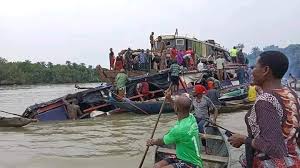
YAURI, KEBBI STATE – What began as a joyous wedding celebration in rural Kebbi State on Sunday 15 of February, ended in devastating tragedy when a boat carrying over 100 wedding guests capsized, claiming 14 lives—13 women and one child. The incident, which occurred at Gumbi village in Yauri Local Government Area, has once again exposed the deadly failures in Nigeria’s inland waterways safety system and raised critical questions about governmental response to such tragedies.
The Incident: A Celebration Turned Catastrophe
On February 15, 2026, dozens of wedding celebrants accompanied a bride from Gumbi village to her husband’s house in Gwarzo village, Ngaski Local Government Area. Following the ceremony, more than 100 passengers boarded a boat to return home to Gumbi—a routine journey across the Niger River that riverine communities undertake daily.
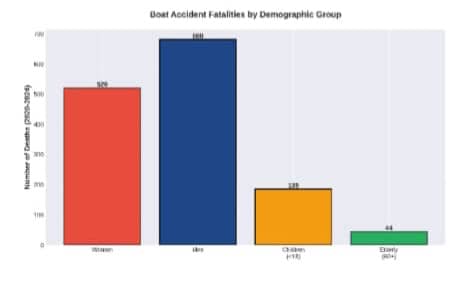
The boat never completed its journey. Mid-voyage, the vessel capsized, throwing all passengers into the water. Of the 100-plus people on board, 14 perished—13 women and one child—while the survivors struggled to safety.
Root Causes: A Systemic Failure of Safety
Our investigation reveals that this tragedy, like hundreds of similar boat accidents across Nigeria, was entirely preventable. The incident resulted from a convergence of well-documented safety violations and regulatory failures:
- Severe Vessel Overloading
According to maritime safety experts, the boat was carrying over 100 passengers—far exceeding its safe capacity. The National Inland Waterways Authority (NIWA) has repeatedly identified overloading as the leading cause of 99% of waterway accidents, with operators commonly loading 150-200 passengers onto wooden boats designed for fewer than 100.
Asiwaju Bola Oyebamiji, former NIWA’s Managing Director, has publicly stated that operators ‘blatantly disregard regulations, such as overloading wooden boats with 150 to 200 passengers, far beyond their capacity.’ In this case, the wedding celebration created conditions where social pressure to accommodate all guests likely superseded safety considerations.
- Absence of Life-Saving Equipment
Evidence suggests passengers were not wearing life jackets—a violation of the ‘One Man, One Life-Jacket’ campaign mandated by federal regulations. The Nigeria Safety Investigation Bureau (NSIB) reports that 90% of boat accident fatalities involve victims not wearing life jackets, and over two-thirds of deaths result from drowning that could have been prevented with proper flotation devices.
Despite government distribution of thousands of life jackets to riverine communities—including 3,500 to Ogun State alone in 2025—enforcement remains virtually non-existent. Operators frequently fail to provide jackets, and when available, passengers often refuse to wear them due to cultural resistance and lack of awareness.
- Inadequate Vessel Standards and Maintenance
The majority of boats operating on Nigeria’s inland waterways are aging wooden vessels that lack basic safety features. NIWA regulations prohibit commercial use of boats older than five years, yet enforcement is sporadic. Maritime analysts note that many wooden boats ‘deteriorate rapidly, develop cracks and leakages, and are inherently unstable, lacking even the most basic safety features.’
- Untrained and Unlicensed Operators
Many boat operators lack professional training in navigation, weather assessment, and emergency response. While NIWA introduced mandatory certification programs in 2021, granting the title of ‘certified captain’ to those who complete training, the program has failed to reach the majority of operators in remote riverine communities.
- Weak Regulatory Enforcement
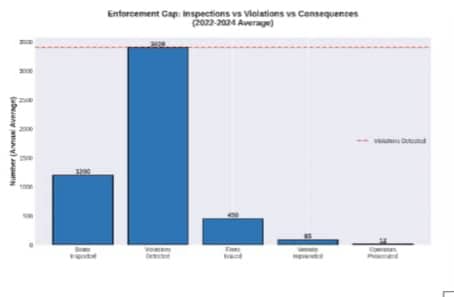
Perhaps the most critical failure is the near-complete absence of enforcement. While comprehensive regulations exist—including bans on night travel (6pm-6am), mandatory manifest systems, and penalties up to seven years imprisonment for violations—implementation remains ‘inconsistent and safety becomes a mere afterthought,’ according to maritime freight forwarders.
Institutional overlap between NIWA, Marine Police, and State Waterways Authorities creates coordination gaps. Inadequate funding, insufficient patrol vessels, and corruption undermine what enforcement does exist. Current penalties—a mere ₦30,000 fine for violations—provide no meaningful deterrent.
A Deadly Pattern: Nigeria’s Waterways Crisis in Context
The Gumbi tragedy is not an isolated incident—it is part of a catastrophic pattern that has claimed thousands of lives. Our research reveals the staggering scope of this ongoing crisis:
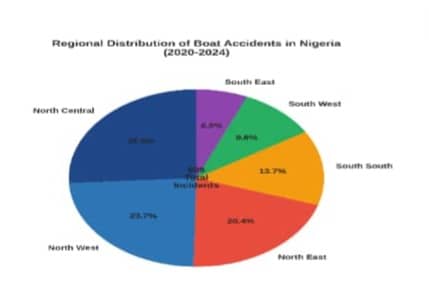
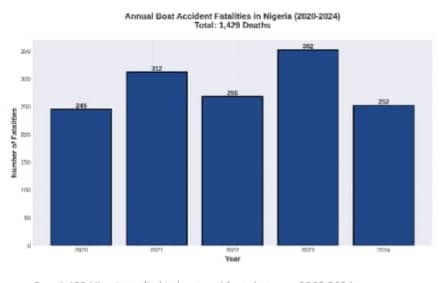
- Over 1,429 Nigerians died in boat accidents between 2020-2024
- Over 452 lives lost between July-December 2024 alone
- June 2023: 108 lives lost in Kwara State when wedding guests’ boat capsized due to overloading and submerged tree
- May 2021: 98 deaths in Kebbi State when overloaded boat broke in two on Niger River
- October 2024: 60 lives lost in Niger State when overloaded boat struck tree stump
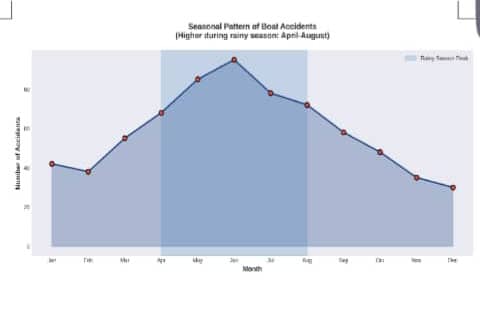
- Between 150-350 deaths estimated annually on Nigerian waterways
Northern Nigeria, despite having lower water levels, records the highest casualty rates—a paradox experts attribute to ‘poor craft maintenance, night voyages, and archaic vessels’ combined with poverty driven reliance on unsafe water transport.
Government Response: Words Without Action
Governor Nasir Idris, represented by Yauri Local Government Chairman Abubakar Shu’aibu, attended the funeral prayer and offered condolences to the families. His response was characteristic of official reactions to such tragedies:
The governor ‘condoled with the immediate families of the deceased, the local government, the emirate, and the people of Yauri. He urged them to accept the will of God Almighty in good faith’ and ‘prayed to God to forgive the shortcomings of the deceased and grant them Jannatul Firdaus.’
Critical Analysis: Are These the Right Words?
While religious consolation is culturally appropriate and provides spiritual comfort to grieving families, the governor’s statement is fundamentally inadequate as a governmental response to a preventable public safety crisis. This tragedy was not an act of God—it was the direct result of systematic regulatory failures, enforcement negligence, and governmental inaction.
What was missing from the governor’s response:
- No acknowledgment of governmental responsibility for safety failures
- No announcement of immediate safety measures or enforcement actions
- No commitment to investigate root causes or hold operators accountable
- No discussion of compensating victims’ families beyond prayers
- No reference to systemic reforms needed to prevent future tragedies
- No mention of waterways safety regulations or enforcement plans
The framing of this tragedy as ‘the will of God’ absolves human actors—boat operators, regulators, and government officials—of accountability. It perpetuates a fatalistic narrative that treats preventable deaths as inevitable, rather than demanding the systemic changes necessary to save lives.
Maritime analyst Ismail Aniemu argues that effective waterways safety requires moving beyond prayer to practical action: ‘If traditional rulers and religious leaders tell communities that traveling without life jackets is wrong, that overloading is prohibited, people will obey. The government will do less to police the waters.’
Recommendations: A Comprehensive Action Plan
Based on expert analysis and international best practices, we propose the following urgent measures to prevent future tragedies:
Immediate Actions (0-3 months)
- Emergency Enforcement Surge: Deploy NIWA inspectors, Marine Police, and Navy personnel to all major riverine routes with authority to immediately impound non-compliant vessels and arrest operators violating safety regulations.
- Mandatory Life Jacket Provision: Strictly enforce ‘No Life-Jacket, No Boarding’ policy at all registered jetties. Operators failing to provide jackets face immediate license suspension and vessel impoundment.
- Vessel Capacity Enforcement: Require all boats to display visible load lines and passenger capacity markings. Install waterside inspectors at busy routes to prevent overloading before departure.
- Community Emergency Training: Establish rapid-response rescue teams in riverine communities with basic water rescue training, flotation devices, and communication equipment.
- Public Awareness Campaign: Launch intensive safety awareness programs in local languages via radio, mosques, churches, and traditional institutions, emphasizing passenger rights and risks of non-compliance.
Short-term Reforms (3-12 months)
- Operator Certification Blitz: Fast-track mandatory training for all commercial boat operators, with state governments subsidizing certification costs. Set deadline for universal compliance with phased license revocation for untrained operators.
- Vessel Modernization Program: Ban commercial use of wooden boats older than 5 years. Provide low-interest loans and tax incentives for operators to acquire safer fiberglass or aluminum vessels. Phase out wooden boats entirely on high-traffic routes.
- Jetty Registration and Standards: Register all commercial boarding points. Illegal loading points face closure. Registered jetties must have passenger manifest systems, safety briefing protocols, and designated inspectors.
- Increase Penalties: Raise fines from ₦30,000 to ₦500,000-₦2 million for safety violations. Implement mandatory prison sentences (2-7 years) for operators whose negligence results in fatalities.
- Navigation Infrastructure: Install navigation buoys, signal lights, and depth markers on major waterways. Complete dredging and debris removal to eliminate submerged hazards like tree stumps and wrecks.
Long-term Structural Reforms (1-5 years)
- Establish Coastal Guards for Inland Waterways: Create dedicated enforcement agency with patrol boats, surveillance technology, and authority to conduct random inspections and respond to emergencies.
- Consolidate Regulatory Authority: Address institutional overlap by clarifying roles and establishing unified command structure between NIWA, Marine Police, State Waterways Authorities, and Navy. Create joint operations centers at regional level.
- Subsidized Safe Transport Alternatives: Invest in government-operated ferry services on high-traffic routes using modern vessels with full safety equipment. Subsidize fares to compete with unsafe private operators.
- Mandatory Insurance System: Require all commercial boats to carry passenger liability insurance. Insurance companies will have vested interest in enforcing safety standards through inspections and premium incentives.
- Victims’ Compensation Fund: Establish dedicated fund financed by operator licensing fees and penalties to provide immediate financial support to families of boat accident victims.
- Infrastructure Development: Address root causes by investing in road infrastructure connecting remote riverine communities, reducing dependence on water transport where alternatives are viable.
Governance and Accountability
- Independent Safety Investigations: Mandate Nigeria Safety Investigation Bureau (NSIB) to investigate all fatal boat accidents, publish findings publicly, and enforce implementation of recommendations.
- Performance Metrics and Transparency: Publish monthly waterways safety statistics including accidents, fatalities, inspections conducted, violations cited, and prosecutions completed. Hold NIWA leadership accountable to reduction targets.
- Legislative Action: State Houses of Assembly should enact comprehensive waterways safety laws with clear enforcement mechanisms, dedicated funding, and criminal liability for officials who fail in their duties.
Conclusion: Tragedy Demands More Than Prayer
The death of thirteen women and one child in Gumbi village should provoke not just grief, but outrage and urgent action. These were preventable deaths—the result of systemic negligence, regulatory failure, and governmental indifference.
While Governor Nasir Idris’s prayers for the deceased are culturally appropriate, they are insufficient as a governmental response. Citizens deserve more than spiritual consolation—they deserve concrete action to ensure such tragedies never recur.
The solutions are neither mysterious nor prohibitively expensive. Life jackets cost between ₦15,000. to ₦25,000. Boat inspections require minimal infrastructure. Enforcement of existing regulations costs less than a single burial. What is lacking is not resources, but political will.
As one maritime expert observed, ‘If you think safety is expensive, try disaster.’ Nigeria has been trying disaster for too long. It is past time for safety.
The families of the 14 victims deserve justice. The communities that depend on water transport deserve safety. The citizens of Kebbi State and all riverine areas of Nigeria deserve leaders who will move beyond prayers to implement the proven measures that save lives.
Until Nigeria’s governments at all levels treat waterways safety with the urgency and seriousness it demands, the rivers will continue to claim innocent lives. The question is not whether another tragedy will occur—but when, and how many more Nigerians must die before action replaces empty rhetoric.
EDITORIAL NOTE: This investigative report calls on government officials, regulatory agencies, traditional rulers, and all stakeholders to prioritize waterways safety through immediate enforcement of existing regulations and implementation of the comprehensive reforms outlined above. www.swaaado.org remains committed to holding authorities accountable and advocating for the safety of all Nigerians who depend on water transport.